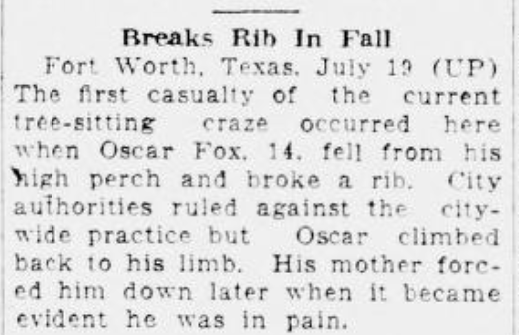
That's right! Kids liked sitting in trees just for the lolz!
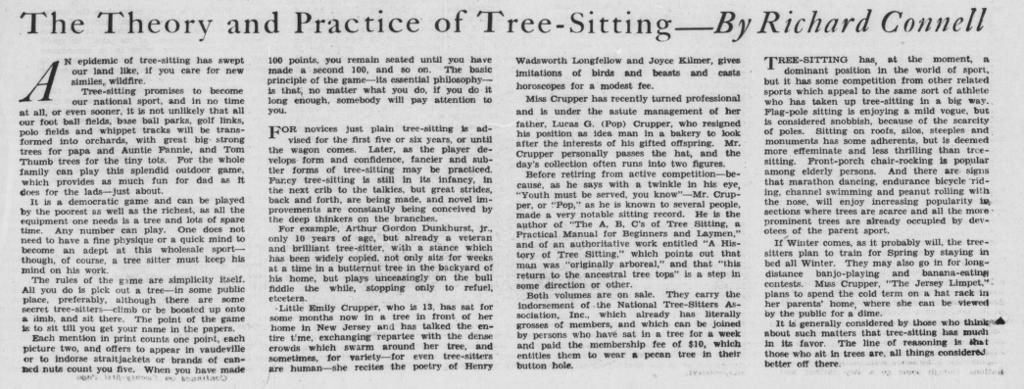
The Theory and Practice of Tree-Sitting
By Richard Connell
A epidemic of tree-sitting has swept the land, like fire for new smiles, wildfire.
Tree-sitting promises to become our national sport, and in no time at all, or even soon, it is not unlikely that polo fields and whippet tracks will be transformed into orchards, with great big strong trees for the big league and tiny Thumb trees for the tiny leaguers. For the whole family can play this splendid outdoor sport, which promises to be fun for dad as well as the lads—just about.
It is a democratic game and can be played by the poorest as well as the richest, as all the equipment one needs is a tree and lots of spare time. Any number can play. One does not even need a fine player to qualify to become an adept at this wholesome sport—though, of course, a tree sitter must keep his wits about him.
The rules of the game are simplicity itself. Preferably, although there are some secret tree-sitters—climb up or boosted up onto a limb. The purpose of the game is to sit till you get your name in the papers. Each mention in print counts one point, each picture two, and others appear in vaudeville or to endorse straitjackets or brands of canned nuts count you five. When you have made 100 points, you remain seated until you have made a second 100, and so on. The basic principle of the game—its essential philosophy—is that what you do, if you do it long enough, somebody will pay attention to it.
For novices just plain tree-sitting is advised as the first five or six years, or until you get the hang of it. As the body develops form and confidence, fancier and subtler forms of tree-sitting may be practiced. Parachute tree-sitting is still in its infancy. In the next fifth are the talkies, but great strides since and forth, are being made, and novel improvements are constantly being contrived by all the deep thinkers on the branches.
For example, Arthur Goodenough, Jr., who is only 10 years of age, but already a veteran and brilliant tree-sitter, with a stance which has been widely copied, not only for wearing a time in a butternut tree in the backyard of his home, but plays unceasingly on the bull fiddle while, stopping only to refuel, etc.
“Little Billy Crupper, who is 12, has sat for some months now in a tree in front of his home in New Jersey and has talked the entire time, exchanging repartee with the dense and the squirrels, and awards for his prowess, sometimes, for variety—for even tree-sitters are human—he recites the poetry of Henry Wadsworth Longfellow and Joyce Kilmer, gives imitations of birds and beasts and casts horoscopes for modest fees.
Miss Crupper has recently turned professional and is under the astute management of her father, Lucas G. (Pop) Crupper, who resigned his position as adviser to his daughter to look after the interests of his gifted offspring. Mr. Crupper personally passes the hat, and the elder deliberately runs into two figures.
Before retiring from active competition—because, as he says with a twinkle in his eye, “Youth must be served, you know”—Mr. Crupper, or “Pop,” as he is known to several people, made a very notable record. He is the holder of “The A. B. C. of Tree-Sitting,” a Practical Manual for Beginners and Laymen,” and of “The Tree-Sitter’s Guide,” a sort of “Tree Sitting,” which points out that man was “originally arboreal” and that “this return to the ancestral tree-tops” is a step in both directions or other.
Both volumes are on sale. They carry the indorsement of the National Tree-Sitters Association, Inc., which already has literally scores of members, and which can be joined by persons who have sat in a tree for a week and paid the membership fee of $10, which entitles them to wear a pecan pin in their button hole.
TREE-SITTING has, at the moment, a dominant position in the world of sport, but it has some competition from other related sports which appeal to tree-sitting in a big way. Flag-pole sitting is enjoying a mild vogue, but it is considered probably less hazardous than sitting on roofs, alone, steeples and monuments has some adherents, but it is deemed less soul-satisfying than tree-sitting. Front-porch chair-rocking is popular among elderly persons. And there are signs that marathons—endurance bicycle riding, channel swimming and peanut rolling with the nose, will enjoy increasing popularity if anywhere there are scarce at all the most prominent trees are already occupied by devotees of the parent sport.
Of course, it is probably that the tree sitters plan to train for Spring by staying in bed all Winter. They may also go in for long-distance banjo-playing and bathing contests. Miss Crupper, the “Jersey Limpet,” plans to spend the cold term on a hat rack at the public for a dime.
It is generally considered by those who think about such things that tree-sitting has much in its favor. The line of reasoning is that those who sit in trees are all things considered better off up there.